
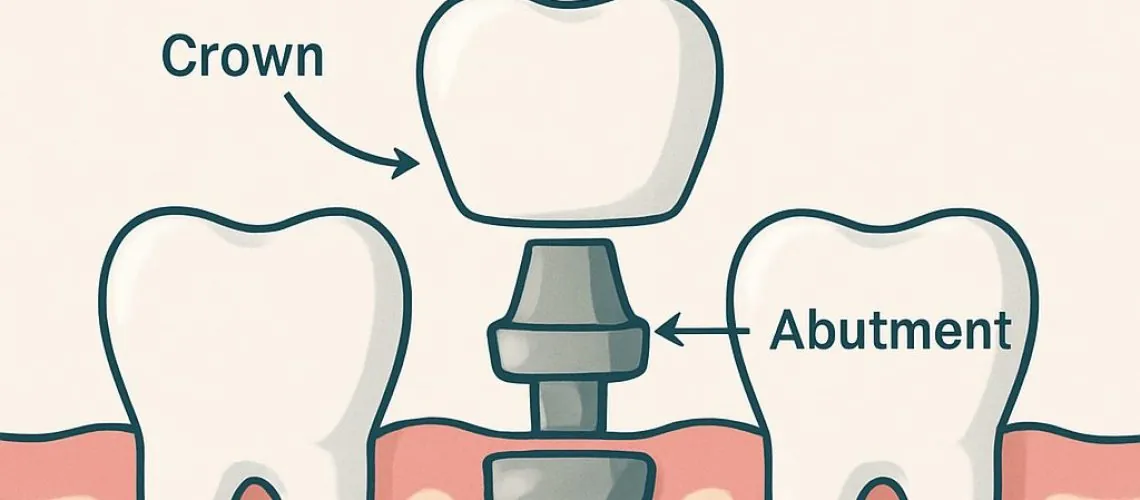
What is abutment in dental implant? An abutment is the small connector piece that joins the implant post (the part placed in your jaw) to the visible crown or denture. This post answers that question simply and explains the abutment’s purpose, the main types, who places it, how your general dentist finishes the restoration, and what to expect during healing.
What an abutment is and how it works
An abutment is a connector. Think of the implant post as an artificial tooth root. The abutment screws into that root and gives the crown, bridge, or denture something solid to attach to. It helps transfer chewing forces from the bite down into the bone so the restoration is stable and long-lasting. Without a properly fitted abutment, the crown won’t seat correctly and the bite won’t feel right.
Common types of abutments
Abutments come in different designs depending on the case and the final restoration.
Stock vs. custom abutments
Stock abutments are off-the-shelf parts that fit many implant systems. They are cost-effective and work well for standard cases. Custom abutments are milled in a lab or CAD/CAM mill to match the exact shape of your gum and crown. Custom abutments give a better fit, improved gum contour, and often better esthetics—especially for front teeth or unusual anatomy.
Materials: titanium, zirconia, and others
- Titanium: Very strong and biocompatible. The most common choice for durability and long-term success.
- Zirconia: Tooth-colored and more esthetic for front teeth. Good when you want no metal show-through at the gum line.
- Hybrid options: Metal bases with ceramic covers combine strength and esthetics for some cases.
The oral surgeon’s role: placing the post and abutment
Oral surgeons place the implant post and often the abutment during the surgical phase. At New Smile Now, Dr. Edward Halusic and the surgical team focus on accurate implant placement and proper healing. Surgeons use precise planning and surgical techniques to position the implant so the abutment and final crown will fit well later. Surgeons generally do not place the final crown; that step is completed by your general dentist, who handles the prosthetic restoration.
What happens during abutment placement and recovery
There are two common steps: a healing abutment (also called a healing cap) and then a final abutment.
- Healing abutment (also called a healing cap): Placed after the implant integrates or at a second-stage surgery. It shapes the gum while the site heals.
- Final abutment: Placed when the tissues are ready and the implant is stable. This is what the crown attaches to.
Procedures can be done with local anesthesia, IV sedation, or general anesthesia depending on your needs and the complexity. After placement you can expect soreness, mild swelling, and some bleeding for 24–72 hours. Basic home care—ice, soft foods, salt-water rinses, and following medication instructions—usually helps the site heal in a few days to a few weeks. Full bone integration takes longer, often a few months, before the final crown is attached.
How the crown or prosthesis gets attached (collaboration with your GP)
Once the abutment is in place and the tissues are stable, your general dentist takes over for the prosthetic steps:
- Impressions or digital scans to capture the exact shape of the abutment and surrounding teeth
- Lab work or in-office milling to make the crown, bridge, or denture
- Trial fitting and adjustments for bite, fit, and esthetics
- Final attachment and patient instructions for care
Your surgeon and dentist coordinate these steps so the implant, abutment, and crown fit together smoothly.
Possible problems and when to contact your care team
Most implants and abutments heal without trouble, but watch for:
- Increasing pain, swelling, or fever (possible infection)
- Loose abutment or crown
- Persistent bleeding or numbness
- Bad taste, pus, or increasing redness
- Esthetic concerns like metal showing at the gum line
Call your oral surgeon right away for severe pain, heavy bleeding, signs of spreading infection, or new numbness. Contact your general dentist first for loose crowns, bite problems, or esthetic adjustments—your dentist handles the prosthetic part and can often fix these quickly.
Technology and techniques that improve abutment outcomes
Modern tools reduce risk and improve fit:
- CT-guided planning helps place implants at the exact angle and depth needed
- Digital dentistry and intraoral scans speed up precise abutment and crown design
- All-on-4 planning and guided surgery improve full-arch outcomes
- IV sedation and anesthesia options make surgery more comfortable
About New Smile Now and the surgical team
New Smile Now, Home of The Facial Surgery Center, serves Greensburg and Monroeville with a team of four oral and maxillofacial surgeons. Dr. Halusic leads implant planning and placement; Dr. Ryan McCloy is referenced for wisdom teeth and other oral surgery needs. The practice emphasizes safety, CT-guided planning, and coordination with your general dentist to get the best functional and esthetic results.
Next steps / call to action
If you’re wondering “what is abutment in dental implant” for your own care, schedule a consultation to review your case. Bring any prior x-rays or CT scans, a list of current medications, and questions about timing, anesthesia, and costs. New Smile Now coordinates closely with your general dentist so you move from surgery to the final tooth with clear communication and fewer surprises.